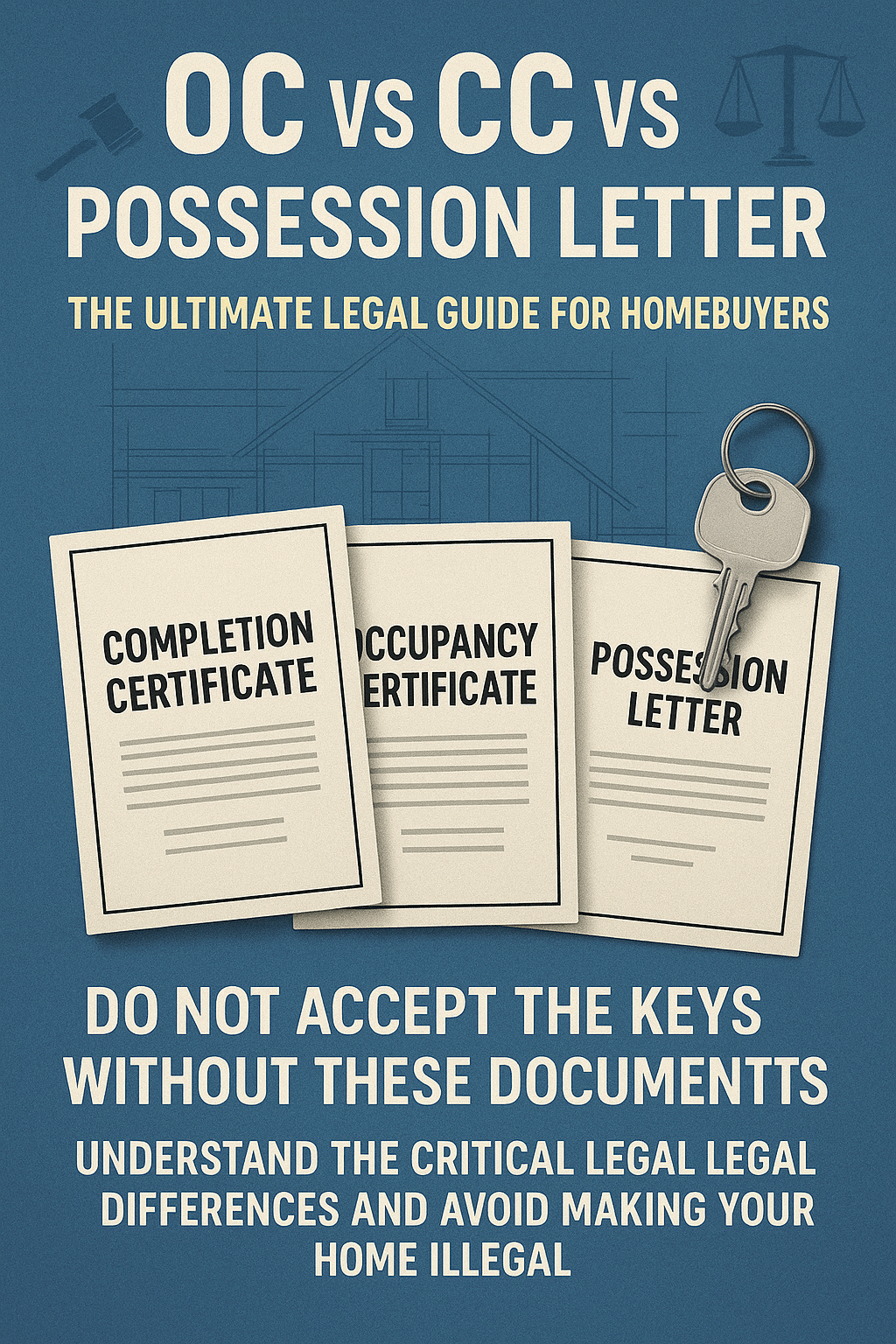
The Legal Trinity: Why Possession Letter, CC, and OC Are Not the Same Thing
You have paid the builder the final installment. The building looks ready. The security guard is at the gate, the lobby lights are on, and the elevators are running. The builder hands you a set of shiny keys and a document on their letterhead titled "Possession Letter."
You stand in your new living room and think, "Finally, I am a homeowner."
Technically, however, you might be an illegal occupant in your own house.
In the excitement of getting the keys and planning the housewarming ceremony, thousands of homebuyers in India make a fatal error every year: they confuse physical possession with legal possession. Just because you can live in a flat doesn't mean you should—or that the law permits you to.
There are three documents that define the birth of a building: the Completion Certificate (CC), the Occupancy Certificate (OC), and the Possession Letter. While they sound similar and are often used interchangeably by sales agents to confuse buyers, they serve completely different legal purposes. Missing even one of them can leave you with a home that has no municipal water supply, cannot be sold, or—in extreme cases—faces the risk of demolition.
This comprehensive guide decodes the "Legal Trinity" of real estate documents so you know exactly what to demand before you crack that coconut at the doorstep.
The Completion Certificate (CC): The Proof of Structural Compliance
The first milestone in a building's lifecycle is the Completion Certificate (CC). To understand this, you must view the building not as a home, but as a construction project.
The CC is a technical document issued by the local municipal authority (such as the BMC in Mumbai, BBMP in Bangalore, DDA in Delhi, or DTCP in other regions) to the developer. It is not a document that is typically handed to the individual buyer in the original form, but its existence is non-negotiable.
The Completion Certificate certifies that the building has been constructed exactly according to the approved building plan and meets all structural safety norms. When a builder applies for a CC, the municipal engineers visit the site to verify several critical technical parameters. They check if the building height is within the legal limit, if the distance from the road (setbacks) has been maintained, if the quality of materials used meets the standards, and if the building is not encroaching on neighboring land or public roads.
Without a CC, the building is technically still "under construction" or, worse, "illegal." If a builder has completed the project but cannot produce a CC, it is a massive red flag. It often means they have built extra floors illegally, violated the Floor Space Index (FSI) limits, or deviated significantly from the approved plan. Such buildings are theoretically liable for demolition or heavy penalties, and they can never legally apply for the next and most important document: the Occupancy Certificate.
The Occupancy Certificate (OC): The License to Live
If the Completion Certificate is the "body" of the building, proving it exists, the Occupancy Certificate (OC) is its "soul," giving it life. This is arguably the most critical document in the entire home-buying process, yet it is the one most frequently delayed or denied.
The Occupancy Certificate is issued by the municipal corporation only after the CC is granted. It certifies that the building is not just structurally sound but is fit for human habitation. While the CC focuses on concrete and steel, the OC focuses on livability and safety.
When issuing an OC, the authorities confirm that the essential lifelines of the building are in place and functional. They verify that the sewage treatment plant is working, the sanitation lines are connected to the municipal grid, the electricity wiring meets safety standards, and, crucially, that the building has a valid Fire No Objection Certificate (NOC). They also ensure that the lifts have been inspected and certified as safe for daily use.
The critical legal rule that every homebuyer must memorize is this: Legally, no one can move into a building that does not have an OC. If you move in before the OC is issued, the municipality classifies your stay as "illegal occupation," even if you have paid for the flat and hold a registered sale deed. You are essentially squatting in an uncertified structure, and the authorities have the legal right to evict you.
The Possession Letter: A Private Contract, Not a Legal Permit
The third document in this trinity is the Possession Letter. Unlike the CC and OC, which are issued by the government, the Possession Letter is issued by the builder.
This document is a private letter from the developer to the buyer stating that the unit is ready for handover. It usually states the date of possession, confirms that you have paid all dues, and formally hands over the keys to you. It is an important document for your personal records and is often required by banks to release the final tranche of the loan.
However, the trap lies in assigning too much legal weight to this paper. A Possession Letter is not a legal sanction from the government. A builder can give you a Possession Letter even if they do not have an OC or a CC. They might tell you, "Don't worry, the OC will come in six months, you can move in now." This is the most dangerous period for a buyer. Once you accept the Possession Letter and take physical control of the property, the builder's incentive to chase the expensive and bureaucratic process of getting the OC drops to zero. You are left holding the bag in a building that is legally unfit for habitation.
Comparing the Three Documents
To clarify the distinction further, let us compare them directly. The Completion Certificate is issued by the Municipal Authority to confirm that the structure is legal. The Occupancy Certificate is also issued by the Municipal Authority but confirms that the building is livable. The Possession Letter, on the other hand, is issued by the Builder to confirm that the keys have been handed over.
In terms of usage, the CC is required to apply for the OC. The OC is required to apply for municipal water, electricity connections, and legal habitation. The Possession Letter is merely required to physically enter the flat.
The most important distinction is the right to move in. You cannot move in just because you have a CC; the building might still lack fire safety or water. You definitely cannot move in just because you have a Possession Letter; that is a private arrangement that does not supersede the law. You can only legally move in if the building has an Occupancy Certificate.
The "No OC" Nightmare: Real-World Consequences
What happens if you ignore this advice and move in without an OC, as many desperate homebuyers in India end up doing? The consequences range from expensive inconveniences to financial ruin.
The most immediate impact is on your utility bills. Without an OC, the municipality is not legally obliged to provide a standard domestic water connection. You will likely be forced to rely on private water tankers, which are unreliable and expensive. Even if the municipality provides water, they will charge you at "commercial rates," which are often three to five times higher than residential rates. Over ten years, this difference alone can amount to lakhs of rupees in extra maintenance costs.
The second and perhaps more damaging consequence is the impact on resale potential. Ten years down the line, when you try to sell your flat, the prospective buyer will likely apply for a home loan. The buyer's bank will ask for the building's OC as part of their legal due diligence. If you cannot provide it, the bank will reject the buyer's loan application. This renders your property "un-bankable." You will essentially be cut off from 80% of the market (buyers who need loans) and will be forced to sell to cash-rich investors who will demand a massive discount because of the legal flaw.
There is also the risk of demolition. While rare, it is a legal reality. If the OC was denied because the builder constructed illegal floors or violated environmental norms, the authorities have the legal right to demolish the unauthorized portions of the building. The famous Campa Cola Compound case in Mumbai is a stark reminder of how families can face eviction decades after buying their homes due to the lack of proper occupation permissions.
Furthermore, in cities like Bangalore, the lack of an OC prevents you from obtaining a clean property title, known as the "A-Khata." You will be stuck with a "B-Khata" or a provisional register, which forever marks your property as having legal irregularities.
Understanding the "Partial OC"
In large townships or multi-tower projects, you will often encounter the term "Partial OC." This happens when a project has multiple towers (say, Towers A, B, C, D, and E) being built in phases. Towers A and B might be fully complete, while C, D, and E are still under construction.
In such cases, the municipality may grant a "Partial OC" specifically for Towers A and B. This certifies that these two towers are safe and habitable, even though the rest of the project is ongoing. Is it safe to move in with a Partial OC? Generally, yes. A Partial OC makes it legal to live in that specific tower. It allows you to get water and electricity connections for your block.
However, there is a catch. You must ensure that the builder is legally committed to obtaining the "Full" or "Final OC" once the entire project is completed. Sometimes, builders obtain Partial OCs for the residential towers but never finish the common amenities like the clubhouse, swimming pool, or main access roads, meaning the Final OC is never granted. While your home is safe, the lifestyle you paid for remains incomplete.
How to Protect Yourself
Protecting yourself begins with skepticism. Do not take the builder's word that the "papers are in process." Demand to see the documents.
Ask for the original Occupancy Certificate. It will hold the seal of the municipal corporation and the signature of the City Engineer or Town Planner. If the builder refuses to show the original or gives you a photocopy that looks blurry or redacted, be suspicious.
You should also independently check the status on your state's RERA website. Every RERA-registered project is required to upload its legal certificates. Look for the "Project Certificates" or "Downloads" tab on the portal. If the OC has been received, it will be explicitly listed there.
If you are buying a resale property, the Society office is a good source of truth. Ask the Secretary if the building has a full OC. If the building is old and lacks an OC, ask if they have applied for regularization under any state amnesty schemes.
The Golden Rule of real estate possession is simple: No OC, No Key. It is better to pay rent for another three months than to spend the next ten years fighting for a water connection or struggling to sell a property that has no legal "soul." Your home is your sanctuary; ensure it is legal before you make it yours.

Debojyoti Roy
Creative Content Writer
Debojyoti Roy is a seasoned content‑marketing specialist with 6 + years of digital‑marketing experience. Today, he applies that expertise to a field he loves just as much as careers: helping people find the perfect place to live.
At GharPe.com, India’s first 3‑D/VR real‑estate portal, Roy shapes the entire content strategy and sets the platform’s friendly, trustworthy voice. He creates the foundational guides, checklists and explainer pieces that fuel GharPe’s blog, social‑media feeds and in‑app tips, ensuring every post reflects the site’s signature “see‑before‑you‑buy” approach to property search.
Audience focus
Roy zeroes in on first‑time buyers, young families and anyone curious about the Indian housing market. His plain‑language articles demystify topics like: * understanding 3‑D walkthroughs and drone views * comparing new‑build vs. resale properties * decoding RERA approvals and loan eligibility * negotiating price and spotting hidden costs
Voice of empathy & clarity
Having guided job‑seekers through stressful transitions earlier in his career, Roy writes with the same empathy for house‑hunters. He anticipates their worries (down‑payment deadlines, paperwork jargon, FOMO on better deals, etc.) and answers them in clear, actionable steps that make the buying journey feel manageable.
To make sure this advice reaches everyone who needs it, Roy leans on deep SEO knowledge: keyword mapping for location‑based searches, schema for property listings, and strategic internal‑linking that boosts GharPe’s authority on Google.
Every guide, alert and tip he publishes serves one goal: connecting good people with great homes - fast, confidently and with a little excitement along the way.
Credentials
- Certified Content Marketing Specialist
- Google Analytics Certified
- HubSpot Content Marketing Certified
- SEMrush Content Marketing Toolkit Certified
