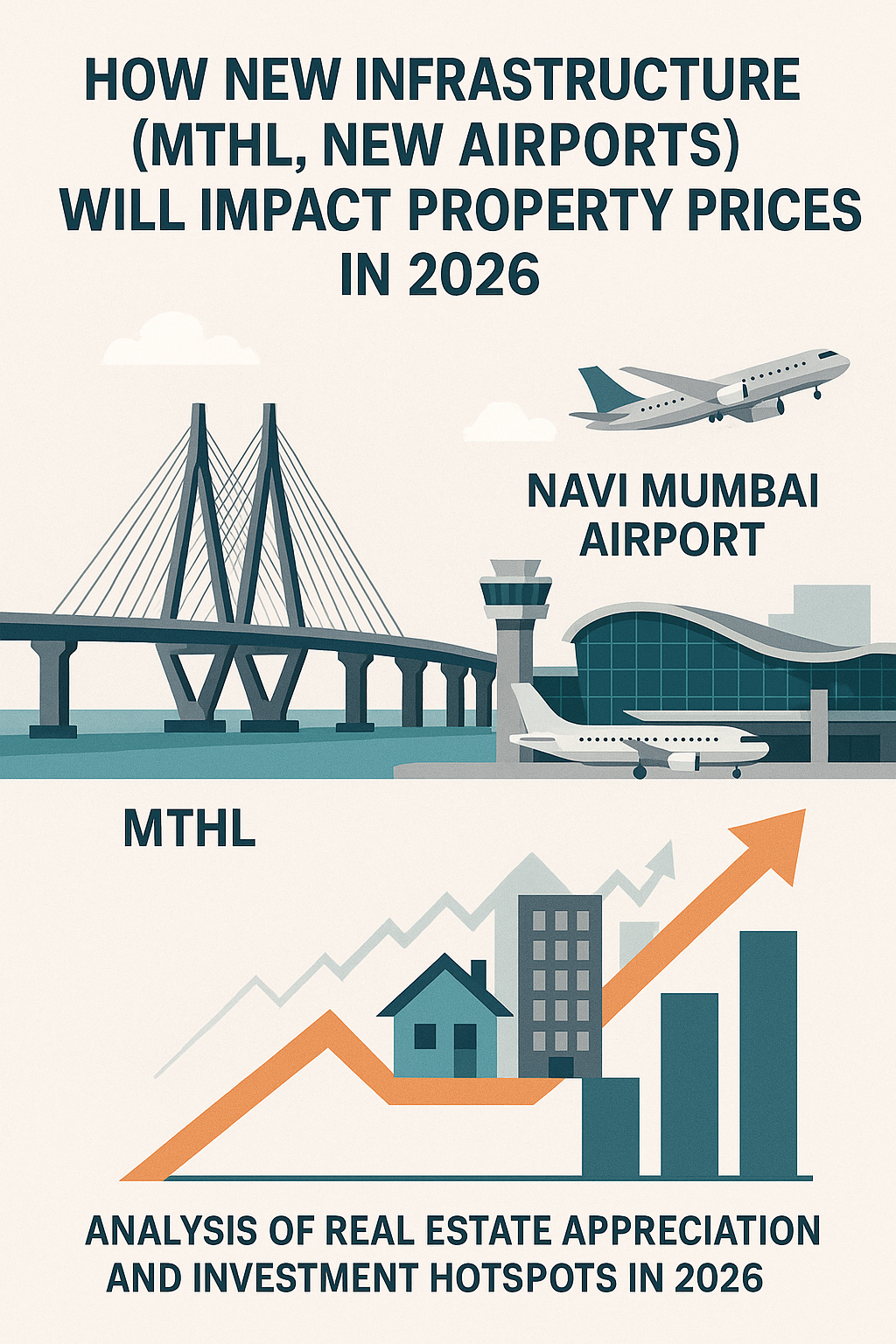
How New Infrastructure (MTHL, New Airports) Will Impact Property Prices in Future
There is an old saying in real estate: "Location, Location, Location." But in a rapidly developing country like India, locations are not just found; they are created.
The magic wand that turns a sleepy, distant village into a booming real estate hotspot is Infrastructure.
As we navigate 2026, India is witnessing an unprecedented infrastructure boom. From the sea-spanning MTHL (Atal Setu) in Mumbai to the massive new international airports in Navi Mumbai and Jewar (NCR), these megaprojects are rewriting the real estate map.
For an investor, understanding the link between concrete and capital appreciation is the key to spotting the next "multibagger" property. This guide analyzes how these projects impact prices and how you can ride the wave.
The "Multiplier Effect": Why Infrastructure Drives Prices
Infrastructure does not just make travel faster; it creates economic ecosystems. * Connectivity: It reduces commute times, making affordable distant suburbs viable for daily work. * Commercial Hubs: Roads and airports attract logistics parks, data centers, and corporate offices, which bring jobs. * Livability: Metro lines and water connectivity improve the quality of life.
When these three factors combine, demand surges, and property prices follow a predictable upward trajectory.
Case Study 1: The MTHL (Atal Setu) Effect
The Game Changer for Mumbai & Navi Mumbai
The Mumbai Trans Harbour Link (MTHL), now fully operational, has fundamentally altered the geography of the Mumbai Metropolitan Region (MMR). * The Impact: It has reduced the travel time between South Mumbai (the old wealth center) and Navi Mumbai (the new growth center) from 2 hours to just 20 minutes. * The Real Estate Result: Areas like Ulwe, Dronagiri, and Panvel—once considered "far-flung"—are now effectively suburbs of South Mumbai. We are seeing a massive price correction (upwards) in these markets as luxury developers launch premium projects for buyers who work in Nariman Point but want affordable luxury in Navi Mumbai.
Case Study 2: The "Aerotropolis" (New Airports)
Navi Mumbai (NMIA) & Jewar (Noida International Airport)
An airport is no longer just a place to catch a flight; it is an economic engine. * The Impact: The new airports in Navi Mumbai and Jewar are being built as "Aerotropolises"—cities centered around an airport. They bring hotels, convention centers, cargo hubs, and MNC offices. * The Real Estate Result: * Navi Mumbai: The airport has turned Pushpak Nagar and Panvel into investment goldmines. Commercial real estate demand is skyrocketing. * NCR: The Jewar Airport has revitalized the Yamuna Expressway and Greater Noida markets, which were stagnant for years. Prices for plots and logistics spaces have nearly doubled since construction hit full speed.
The Metro Rail Effect: The Intra-City Price Booster
While expressways connect cities, Metros connect neighborhoods. * Bangalore & Chennai: The expansion of metro lines into the IT corridors (like Electronic City or OMR) has historically led to a 15-20% price premium for properties within 500 meters of a station. * The "Last Mile" Rule: In 2026, renters prioritize "walk-to-metro" properties above almost all else. Investors buying near upcoming metro stations can expect higher rental yields and consistent occupancy.
How to Time Your Investment: The 3 Stages of Growth
To maximize returns, you must know when to enter the market. Infrastructure impacts prices in three distinct waves:
- The Announcement Phase (Speculative Spike): Prices jump immediately when a project is announced. Risk: High (Project might get delayed).
- The Construction Phase (Steady Growth): Prices rise steadily as pillars go up and progress is visible. Risk: Moderate.
- The Operational Phase (The Final Jump): The moment the ribbon is cut and the first car drives over the bridge, livability spikes. Prices consolidate at a new high. Risk: Low (but entry price is high).
The Smart Move for 2026: Look for projects that are in the late construction phase—where completion is certain within 12-24 months. This offers the perfect balance of safety and remaining appreciation potential.
Conclusion: Follow the Infrastructure
If you want to know where real estate prices will be highest in 2030, don't look at where the luxury towers are today. Look at where the bridges, metro lines, and airports are being built tomorrow. Infrastructure is the ultimate leading indicator of value.
To find properties located in these high-growth infrastructure corridors, explore our Investment Hotspots. For detailed analysis of specific mega-projects, read our Infrastructure Reports at https://gharpe.com.

Debojyoti Roy
Creative Content Writer
Debojyoti Roy is a seasoned content‑marketing specialist with 6 + years of digital‑marketing experience. Today, he applies that expertise to a field he loves just as much as careers: helping people find the perfect place to live.
At GharPe.com, India’s first 3‑D/VR real‑estate portal, Roy shapes the entire content strategy and sets the platform’s friendly, trustworthy voice. He creates the foundational guides, checklists and explainer pieces that fuel GharPe’s blog, social‑media feeds and in‑app tips, ensuring every post reflects the site’s signature “see‑before‑you‑buy” approach to property search.
Audience focus
Roy zeroes in on first‑time buyers, young families and anyone curious about the Indian housing market. His plain‑language articles demystify topics like: * understanding 3‑D walkthroughs and drone views * comparing new‑build vs. resale properties * decoding RERA approvals and loan eligibility * negotiating price and spotting hidden costs
Voice of empathy & clarity
Having guided job‑seekers through stressful transitions earlier in his career, Roy writes with the same empathy for house‑hunters. He anticipates their worries (down‑payment deadlines, paperwork jargon, FOMO on better deals, etc.) and answers them in clear, actionable steps that make the buying journey feel manageable.
To make sure this advice reaches everyone who needs it, Roy leans on deep SEO knowledge: keyword mapping for location‑based searches, schema for property listings, and strategic internal‑linking that boosts GharPe’s authority on Google.
Every guide, alert and tip he publishes serves one goal: connecting good people with great homes - fast, confidently and with a little excitement along the way.
Credentials
- Certified Content Marketing Specialist
- Google Analytics Certified
- HubSpot Content Marketing Certified
- SEMrush Content Marketing Toolkit Certified
