Metro vs Non Metro Are Goa Properties Now Competing With Mumbai Properties on Appreciation
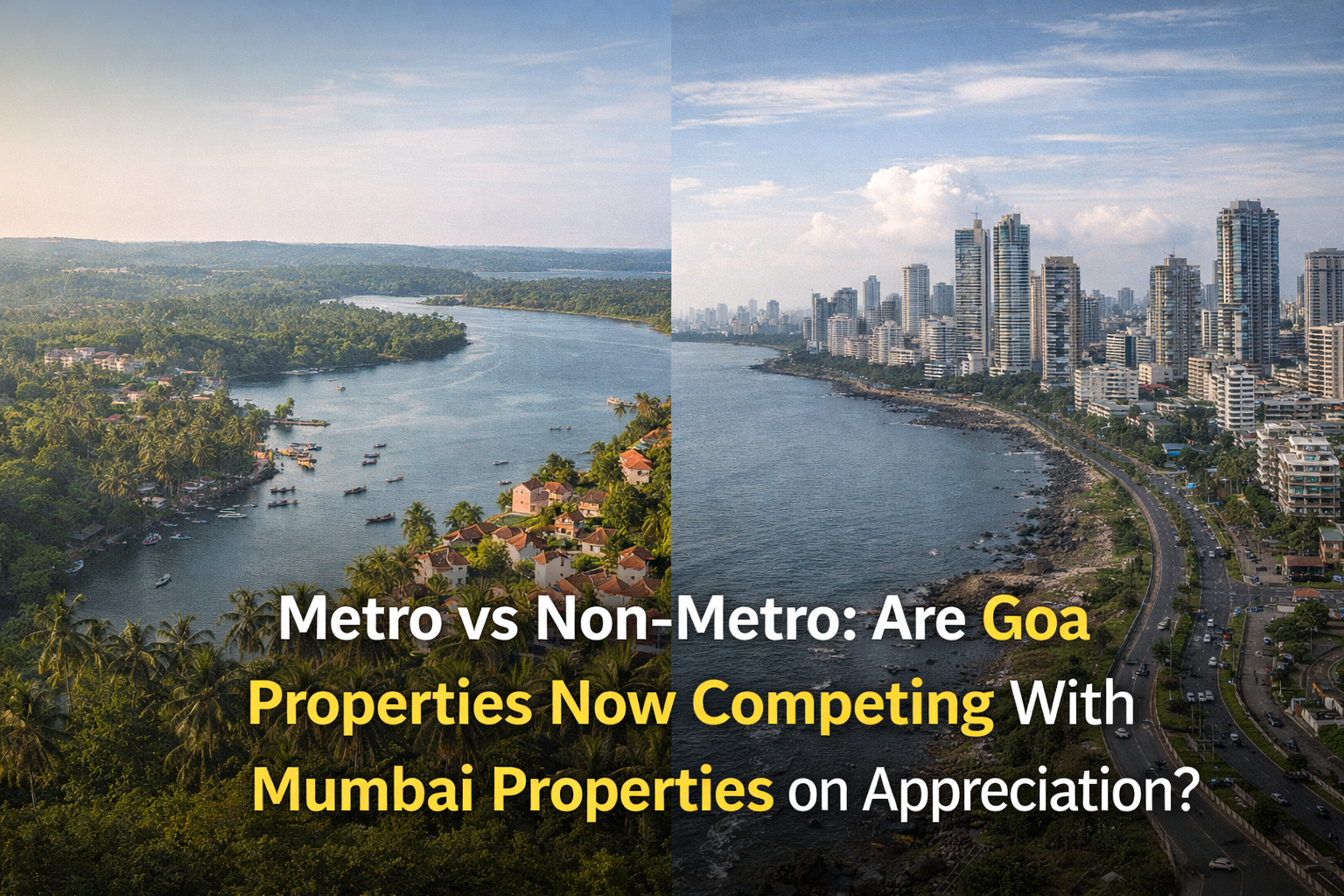
For decades, Mumbai defined property appreciation in India. As the country’s financial capital, it delivered consistent price growth driven by limited land, massive employment demand and constant population inflow. Goa, on the other hand, was seen as a lifestyle market. A place for second homes, holidays and retirement. In 2026, that distinction is no longer as clear as it once was.
Goa Properties are experiencing a fundamental shift. What was once a niche leisure market is now attracting end users, investors, remote professionals and long term residents. This has raised an important question among serious buyers. Are Goa properties now competing with Mumbai properties when it comes to appreciation?
To answer this, we need to look beyond labels like metro and non metro. Appreciation today is driven by demand quality, supply constraints, lifestyle shifts and long term usability. Many buyers start this evaluation using the Home Buyers Guide to understand how non traditional markets evolve into serious investment destinations.
This article compares Goa and Mumbai on appreciation potential, growth drivers and buyer behaviour to see whether Goa is truly catching up.
How Mumbai Became India’s Benchmark for Appreciation
Mumbai’s appreciation story is built on scarcity. The city is geographically constrained, surrounded by water and protected zones. This limits supply while demand remains relentless. Employment opportunities, financial institutions, media, entertainment and global connectivity keep buyers flowing in.
Apartments in Mumbai benefit from this imbalance. Even during economic slowdowns, prices rarely fall significantly. Growth may slow, but long term direction has historically been upward.
This consistency is why Mumbai remains the default benchmark when discussing property appreciation in India.
Why Goa Was Never Compared to Mumbai Before
Traditionally, Goa did not compete with metros on appreciation. Demand was seasonal, largely tourism driven and focused on second homes. Rental income was often short term and inconsistent.
Infrastructure beyond key tourist zones was limited, and long term employment opportunities were fewer. As a result, price growth was uneven and heavily location dependent.
That picture has changed dramatically in recent years.
What Changed in Goa’s Property Market
Goa’s transformation is driven by lifestyle migration rather than traditional employment migration. Remote work, flexible careers and digital businesses have enabled people to choose where they live rather than where offices are located.
Goa offers something Mumbai cannot. Space, greenery, lower density living and a slower pace without sacrificing connectivity. This has brought in buyers who are not looking for holiday homes, but primary residences.
Insights into how this shift is impacting prices can be seen in Goa property prices and 2026 trends, which highlight how demand has moved beyond tourist belts.
Demand Quality Goa vs Mumbai
Mumbai’s demand is employment driven. People buy because they need to live close to work. This creates constant baseline demand.
Goa’s demand is choice driven. Buyers are choosing Goa because it offers a better quality of life. This demand may be smaller in volume, but it is highly committed. Buyers relocating permanently or investing long term are less price sensitive and more focused on lifestyle.
This difference matters. Choice driven demand often leads to stronger appreciation in limited supply markets.
Supply Constraints Are Emerging in Goa
One reason Mumbai appreciates consistently is limited supply. Goa is now experiencing a similar constraint, though for different reasons.
Strict zoning regulations, environmental protections and low density planning restrict large scale development. New supply is controlled and slower to enter the market.
As more buyers compete for limited inventory, prices respond. This is especially visible in coastal and premium residential zones, as highlighted in Beach properties in Goa.
Entry Price Comparison Sets the Stage for Growth
Mumbai prices are already among the highest in the country. While this ensures stability, it also limits percentage growth. Doubling prices from a very high base takes time.
Goa still offers comparatively lower entry prices, especially for premium lifestyle properties. When demand increases from a lower base, percentage appreciation can outpace metros even if absolute prices remain lower.
This is why investors are increasingly comparing Goa not as a holiday market, but as an appreciation play.
Rental Demand Is Supporting Appreciation in Both Markets
Rental demand often predicts price movement. Mumbai has always had strong rental absorption due to employment.
Goa’s rental market has evolved beyond tourism. Long term rentals for professionals, families and retirees are rising. Many buyers now see rental income as stable rather than seasonal.
The shift toward long term tenancy is explored in flats in Goa for long term living and rentals, which shows how rental behaviour is maturing.
Stable rentals support holding power, which supports price growth.
Property Types Driving Appreciation in Goa
In Mumbai, apartments dominate appreciation because land ownership is limited. Demand is spread across compact homes and premium apartments alike.
In Goa, villas and low density luxury apartments are leading appreciation. Buyers value land component, privacy and open space. This gives Goa an edge in certain segments that Mumbai simply cannot offer at scale.
The difference between villas and apartments as appreciation assets is well explained in villas vs luxury apartments in Goa.
Lifestyle Premium Is Now a Real Price Driver
Mumbai’s premium is convenience. Goa’s premium is lifestyle.
As quality of life becomes a priority, buyers are willing to pay more for space, air, light and flexibility. This lifestyle premium is being priced into Goa properties, especially in well connected yet low density areas.
Unlike speculative premiums, lifestyle premiums tend to be sticky. Once buyers accept a higher price for quality of life, they rarely revert.
Mumbai’s Market Is Mature and Predictable
Mumbai remains one of the safest property markets in India. Appreciation is steady, backed by constant demand and strong resale liquidity.
Resources like the Mumbai flats comprehensive guide show how buyer demand spans all segments, from compact homes to ultra luxury residences.
However, maturity also means that dramatic price jumps are less frequent. Growth is incremental rather than explosive.
Goa Is in a Higher Growth Phase
Goa is earlier in its growth cycle. Demand is accelerating, supply is constrained and perception is shifting from vacation market to permanent living destination.
Historically, markets in this phase often see faster appreciation until they stabilise. This does not mean Goa will replace Mumbai, but it can outperform it in percentage growth for a period.
Buyers considering this transition often study buying property in Goa as an investment to understand long term risks and rewards.
Investor Profiles Are Different but Overlapping
Mumbai attracts conservative investors who value capital protection and liquidity. Goa attracts lifestyle investors who value growth and experience alongside returns.
Interestingly, the overlap is increasing. Mumbai investors are diversifying into Goa to capture growth that Mumbai no longer offers at the same pace.
This cross migration of capital is one of the strongest signals of Goa’s rising stature.
Builder Ecosystem Comparison
Mumbai’s builder ecosystem is large, established and regulated. Projects by reputed names maintain value and attract consistent demand, as seen in top builders in Mumbai.
Goa’s builder ecosystem is smaller but improving. Boutique developers focusing on quality and low density projects are gaining trust. This controlled development supports premium pricing rather than oversupply.
Luxury Demand Shows Where Appreciation Is Heading
Luxury is often the first segment to reflect appreciation trends. In Mumbai, luxury demand remains strong but is constrained by price ceilings.
In Goa, luxury demand is expanding rapidly. Buyers who cannot afford similar lifestyle luxury in Mumbai find Goa attractive.
This is why premium Goa properties are seeing sharp interest from NRIs and high net worth individuals.
Resale Liquidity Comparison
Mumbai has unmatched resale liquidity. Properties sell quickly due to constant demand.
Goa’s resale market is improving. While liquidity is lower than Mumbai, it is no longer illiquid. As permanent residents increase, resale depth improves.
This evolution supports appreciation rather than hindering it.
Risk Factors Buyers Must Consider
Mumbai’s risk lies in limited upside rather than downside. Prices are unlikely to fall sharply, but growth may be modest.
Goa’s risk lies in regulatory changes and localised oversupply in poorly planned zones. Location selection is critical.
Buyers who understand micro markets mitigate this risk effectively.
Which Market Suits Which Buyer
Mumbai suits buyers who want:
- Predictable appreciation
- High liquidity
- Employment driven demand
- Long term stability
Goa suits buyers who want:
- Higher growth potential
- Lifestyle plus returns
- Lower entry price relative to value
- Scarcity driven appreciation
Understanding personal goals matters more than choosing a label.
Exploring Live Opportunities
Buyers can explore current listings across Mumbai properties and Goa properties to see how pricing and inventory compare in real time.
A wider national perspective is available through GharPe for those considering diversified portfolios.
Final Answer Are Goa Properties Competing With Mumbai on Appreciation
Goa is not replacing Mumbai. Mumbai remains the benchmark for stability and scale.
However, Goa is now competing with Mumbai in a different way. On percentage appreciation, lifestyle driven value growth and premium scarcity, Goa is emerging as a serious contender.
For the next growth cycle, Goa may very well outperform Mumbai in relative terms, even if Mumbai remains higher in absolute pricing.
Conclusion
The metro versus non metro distinction is losing relevance in Indian real estate. What matters today is demand quality, supply discipline and long term usability.
Mumbai will always be a cornerstone market. Goa, however, is no longer just a holiday destination. It is a growing residential and investment market with real appreciation potential.
For buyers who understand timing and choose locations carefully, Goa properties are no longer an alternative to Mumbai. They are a strategic complement that can deliver both lifestyle and growth in 2026 and beyond.

Sayantan Saha
Content and Social Media Specialist
Sayantan Saha is a K–12 educator and content specialist with a deep passion for simplifying learning. As a real-life teacher, he understands the challenges students and parents face and uses that insight to create optimized, engaging edtech content. His writing blends educational expertise with accessible storytelling, making academic topics easy to understand and relatable for a wide audience.
