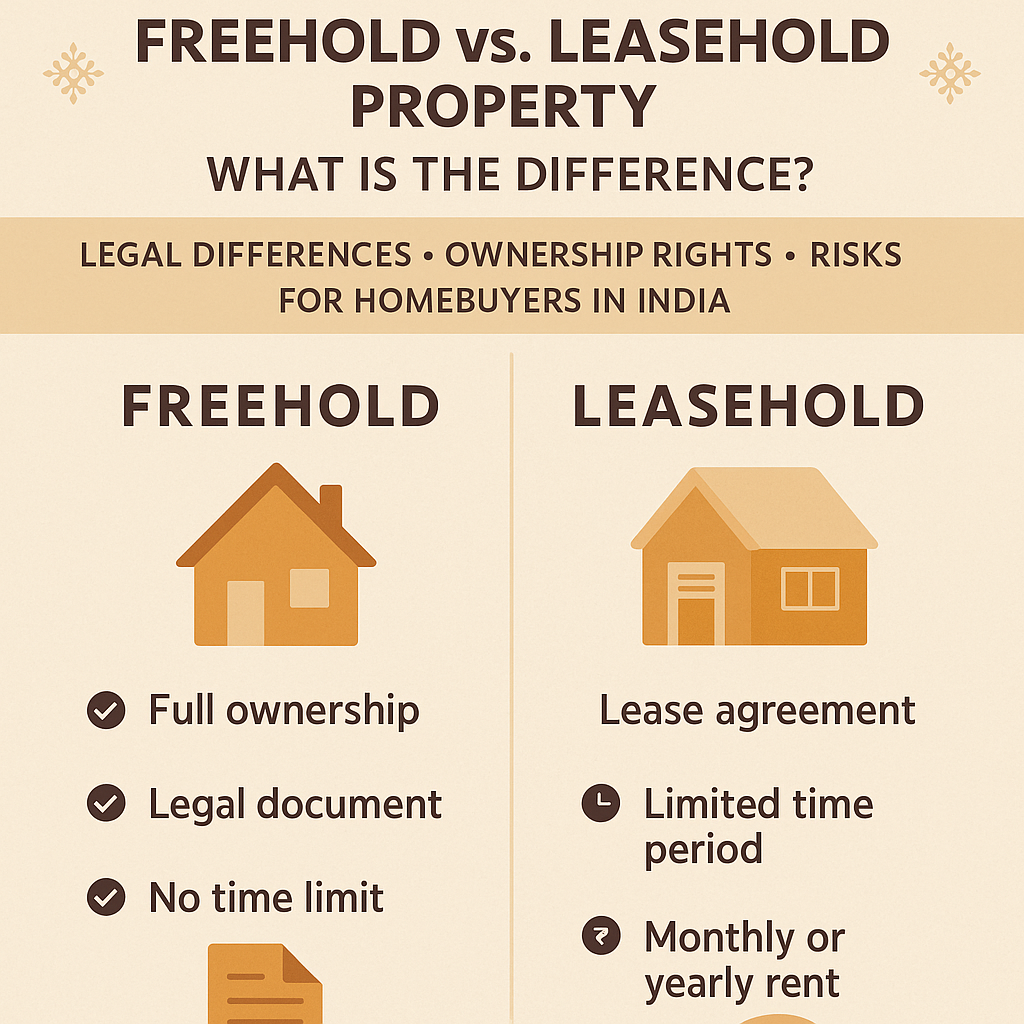
Freehold vs. Leasehold Property: What Are You Actually Buying?
You have found the perfect apartment. The location is great, and the price is surprisingly low. But then you look at the title documents and see a phrase that makes you pause: "Leasehold Land."
In India, not all property ownership is equal. Broadly, ownership falls into two categories: Freehold and Leasehold.
The difference between these two is massive. It affects your ability to sell the property, getting a bank loan, and even whether you truly "own" the land your house sits on. In cities like Delhi (DDA flats), Noida, and Navi Mumbai (CIDCO plots), Leasehold is the norm, while in others, Freehold dominates.
This evergreen guide breaks down the legal jargon to help you understand what you are buying and the risks involved.
1. What is Freehold Property? (The "Gold Standard")
"Freehold" stands for "free from hold" of any entity besides the owner.
- The Definition: You own the building and the land it stands on, exclusively and forever (in perpetuity).
- The Owner: You are the absolute owner. There is no "landlord" above you (except the government for municipal taxes).
- The Rights:
- You can sell, transfer, or mortgage the property without needing permission from the state or authority.
- You can pass it down to your heirs for generations without any paperwork hassle.
- You have the right to rebuild or modify the structure (within municipal bylaws).
The Verdict: This is the most preferred and secure form of ownership. It commands a higher market price because of the total freedom it offers.
2. What is Leasehold Property? (The "99-Year" Rental)
"Leasehold" means you have bought the right to live on the property for a fixed period, but you do not own the land.
- The Definition: The land belongs to the State Government or a Development Authority (like DDA in Delhi, NOIDA Authority, or CIDCO in Navi Mumbai). They lease it to the developer/builder, usually for 99 years.
- The Owner: Technically, the Government/Authority is the "Lessor" (Landlord), and you (or the builder) are the "Lessee" (Tenant).
- The Rights:
- You own the structure (the flat), but the land is rented.
- Transfer Fees: If you want to sell the property, you often need to pay a "Transfer Charge" or get a "NOC" (No Objection Certificate) from the Authority.
- Lease Renewal: At the end of the lease period (e.g., after 99 years), the lease must be renewed, often for a substantial fee. If not renewed, the land goes back to the government.
The Verdict: Leasehold properties are common in planned industrial cities or government housing schemes. They are usually cheaper than freehold properties but come with bureaucratic strings attached.
3. The "99-Year Lease" Myth
Why 99 years? Why not 100? It is a legacy of the British legal system. It is considered a period long enough to cover roughly three generations—effectively "forever" for the current buyer, but legally temporary so the government retains ultimate control over the land use.
Does the lease expire? Yes. Can you renew it? Usually, yes. Authorities typically allow lease renewal for another 99 years upon payment of a renewal fee. However, the uncertainty of how much that fee will be in the future is a risk factor.
4. Key Differences at a Glance
| Feature | Freehold Property | Leasehold Property | | :--- | :--- | :--- | | Ownership | Absolute (Land + Building) | Temporary (Building Only) | | Duration | Forever | Fixed (e.g., 30, 99, or 999 years) | | Transfer | Easy (Direct Registry) | Complex (Needs NOC/Transfer Fees) | | Bank Loans | Easy to get | Possible (if lease > 30 years left) | | Cost | Premium Price | Lower Price | | Control | Full control to modify | Limited (need Authority permission) |
5. Can You Convert Leasehold to Freehold?
Yes. In many cities, Development Authorities allow "Freehold Conversion". * The Process: You pay a "Conversion Charge" to the Authority (e.g., DDA or local municipality). * The Result: They sign a "Conveyance Deed" transferring the land rights to you. The property becomes Freehold. * Why do it? It instantly increases the property's market value (often by 15-20%) and makes it easier to sell or mortgage.
Conclusion: Which Should You Buy?
- Buy Freehold If: You want complete peace of mind, plan to pass the property down for generations, and want the freedom to sell without government interference.
- Buy Leasehold If: You are buying in a specific planned city (like Noida or Navi Mumbai) where all land is leasehold, or if you are looking for a more affordable entry point into a prime location.
Just ensure that if you buy Leasehold, the remaining lease period is substantial (at least 30+ years) to ensure bank loan eligibility.
To check the ownership status of properties and find verified Freehold options, browse our Verified Listings. For assistance with legal due diligence, consult our Legal Experts at https://gharpe.com.
